
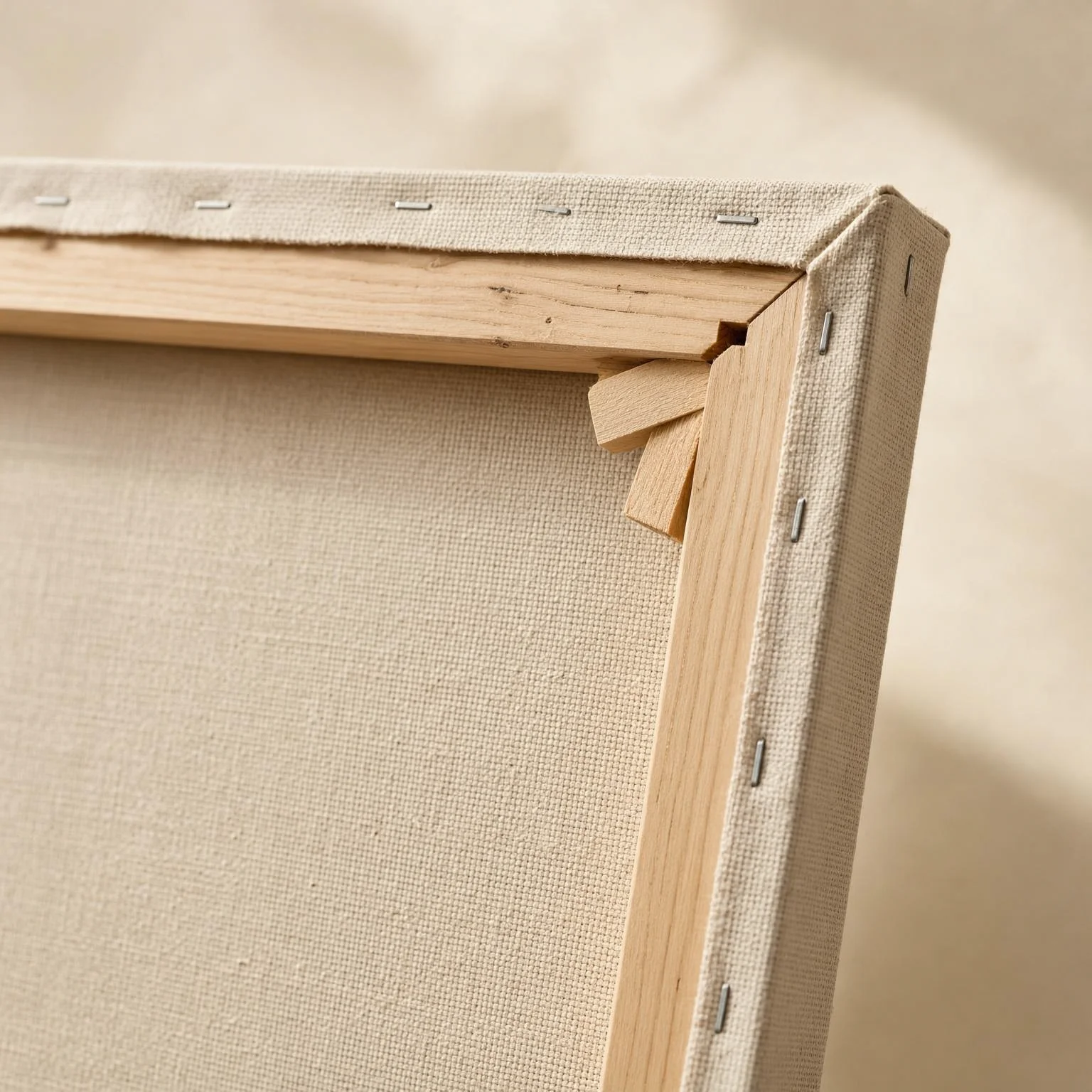
For many artists, buying a painting canvas means visiting an art supply store and choosing from a rack of identical, mass-produced, ready-made canvases. For practice pieces and small studies, this is perfectly reasonable. But when it comes to professional work — pieces destined for galleries and serious collectors — that limited choice can quietly become a real obstacle.
In this article, we look at the difference between ready-made and custom canvas, and why the quality of your painting surface matters far beyond a "technical detail": it can affect the longevity of your work, the way you paint, and even how your art is priced — without ever reducing artistic value to the cost of materials.
The Canvas Is the Foundation — Not the Whole Story
Let's be clear from the start: the true value of an artwork lives in the artist's vision, skill and voice. No expensive canvas can save a weak painting, and no one claims that good materials make art. But technically, the canvas is the skeleton of a painting — the surface that must hold the paint for decades.
Professionals put it simply: the difference between a painting that endures for centuries and one that deteriorates within a decade often comes down to materials. The canvas, the paint and the stretcher form the "invisible architecture" that gives a work its depth and permanence (Artdependence). Choosing a professional surface is about giving your work the foundation it deserves.
Linen or Cotton? Know Your Surface
Two fibres dominate the world of painting canvases: linen and cotton.
- Cotton canvas is affordable, widely available, and a great choice for practice and large-scale work. However, it can slacken over time and is more vulnerable to moisture (Fine Art Tutorials).
- Linen canvas, woven from flax, has fibres 2–3 times stronger than cotton, greater dimensional stability, and better resistance to humidity. It is the surface of choice for professional and classically trained artists who want their work to last (Utrecht Art), and is still regarded as the "gold standard" (Winsor & Newton).
Linen also has a finer, more natural texture that suits detailed work better, since the pronounced tooth of cotton can swallow fine lines (Fine Art Tutorials). Weight and weave matter too — as does priming: professional canvases typically carry two to four coats of quality primer, while budget ones often have a single thin coat (Jackson's Art).
How Material Quality Supports Your Art's Value
Let's speak honestly: for an artist who sells work, material quality is not just a technical concern — it is an economic one.
Many artists try to cut material costs to maximise profit. But that calculation usually runs one way only. With better materials, the upfront cost is higher, yet the work can sell at a higher minimum price — and the final profit, not just the sale price, can be considerably greater.
This isn't marketing talk. Collectors invest in works that are built to last. According to art-market professionals, a painting's physical integrity and material soundness directly affect how it is received and valued (We Art Online). Galleries and serious buyers notice the difference between an inexpensive commercial board and a properly prepared Belgian linen — and it shapes their expectations (r/artcollecting).
To be clear: none of this means artistic value is measured by material cost. Artistic value is often impossible to quantify — and that intangible value can itself powerfully influence price.
Good materials guarantee the professional minimums, so your valuable work is seen and preserved in a worthy setting — and its story is never compromised by a weak surface.
The Challenge of Buying Professional Canvas
Here is the reality many artists face: even professional painters are often limited to mass-produced, ready-made canvases, with little choice of fibre, weave, weight or precise dimensions. Too often, an artist has to adapt a work conceived in a specific size and texture to whatever is available — rather than the other way around.
Internationally, serious painters routinely buy raw canvas and have it prepared to suit each piece: selecting the fibre, the weight of the weave, the ground, the exact dimensions, even the stretcher construction (Momaa).
Parshan's Answer: Custom-Stretched Canvas
This is where Parshan comes in. Our goal is custom canvas — from the choice of fabric and texture to exact dimensions and preparation — built to match the style, method and taste of each artist and each artwork. A surface made for you and for the specific work you imagine, not a surface you have to compromise with.
Professional artists no longer have to choose between "the canvas that exists" and "the work they want to create."
For Students: Learn Materials, Save Smartly
And a word for artists just starting out. You might think professional canvas talk is premature — but the opposite is true. Learning about different canvas materials early can help you spend less, not more. When you know which weave and fibre suit which style, you won't need to buy the most expensive option for every study.
A developing artist can buy according to the real needs of each situation — daily practice, a final piece, a particular technique — while becoming familiar with professional materials and their uses. Parshan is here for that journey too: whether you're exploring materials or commissioning the first serious canvases your work deserves.
Conclusion
The canvas is where your work is born, and the surface your audience ultimately sees. Choosing between a ready-made canvas and a custom painting canvas is the choice between adapting your art to a surface — or building a surface for your art. If you're practising, a good economical canvas is enough. But if you're creating work meant to be seen, to last, and to hold its value, think carefully about what you paint on — not as an expense, but as an investment that pays back into your work and your career.
Have you felt the limits of ready-made canvases, or do you have questions about choosing the right surface? We'd love to help you at Parshan — our contact page is always open, and your custom canvas is waiting.